How to Incubate Chicken Eggs: Incubation Through Hatch
Hen egg incubation from set to hatch: temperature, humidity, candling, lockdown, brooder prep, and troubleshooting—written for homesteaders who want incubator results without guessing.

If you want reliable chicks without gambling on a broody hen, you need a repeatable egg incubation process. This guide explains how to incubate fertile chicken eggs in a home incubator: what to measure, when to candle, how lockdown works, and what to do when something drifts off-spec. Practice now so a grid-down or supply shock does not leave you short on birds.
Incubation and hatching of chicken eggs: why bother?
Incubation and hatching of chicken eggs under a mechanical incubator scales better than egg brooding from a hen alone. One good incubator can handle a full clutch (or more) with predictable turns and humidity steps—useful when:
- Popular laying breeds have been selected against broodiness, so broody hens are scarce.
- A hen starts setting, then abandons the nest after a week or two.
- You want more than a dozen chicks in one batch for restocking meat or eggs.
- You are thinking ahead about barter, trade, or food security and need spare capacity beyond what nature offers.
Hen egg incubation is not mysterious: it is heat, moisture, fresh air, and gentle movement that mimic what a sitting hen does. Your job is to hold those variables steady enough that embryos develop without drying out or drowning at hatch.
How eggs are hatched (quick biology)
An embryo starts when a fertile egg is held near brooding temperature for long enough. Below that band, development pauses; in the incubator, you intentionally hold the band until organs and feathers form. Near the end, the chick pierces the internal membrane, “pips” the shell, zips around, and exits. Healthy hatch timing clusters around a narrow day range for chickens when temperature is correct.
Fertility, flock ratios, and collecting eggs
For fertile eggs, hens need time with a compatible rooster. A common rule of thumb is about one rooster per six to eight hens for reliable coverage; bantam roosters sometimes cover 10–12 hens depending on temperament and space. Tighter ratios reduce drama but do not guarantee every egg on every day is fertile—candling later confirms reality.
Collect eggs often so they stay clean. Dirty shells are the main reason people reach for washing; washing can pull bacteria through pores if done wrong (cold water against a warm egg is especially risky). Best practice is clean nest boxes so eggs need little more than a dry wipe. If you must wash, use warm water only and accept slightly lower odds than pristine eggs.
Storing eggs before you incubate
Hens often lay a clutch over seven to ten days before starting to sit. You can mimic that: store pointed-end-down in a cool, stable spot (not the fridge door) and aim to set within about four to eight days for best results; pushing toward the longer end still works for many flocks but costs you a few points of hatch rate.
Label set date and orientation if you will turn by hand—a pencil mark on one side beats guessing after three days of rotations.
Incubator reality check before day one
How to hatch eggs in an incubator starts with honest equipment prep:
- Still-air vs forced-air models read temperature differently. Forced-air (fan) commonly targets about 100°F at embryo height; still-air runs a few degrees higher at the top because of stratification—follow your manual, verify with a calibrated probe at egg level, and do not mix recipes between styles.
- Hygiene: sanitize the chamber, trays, and lid gasket; leftover fluff and dust encourage bacteria.
- Redundancy: a short outage can cook a batch. Think extension cord integrity, GFCI trips, UPS for small incubators, and who checks it twice a day if you travel.
The egg incubation process (day-by-day overview)
This is the backbone workflow most backyard chicken keepers follow on chicken eggs (~21 days). Always reconcile with your incubator manual and thermometer calibration.
- Warm up the incubator empty until temperature and humidity stabilize at egg level.
- Set labeled eggs, start automatic turning—or schedule three to four gentle hand turns per day.
- Track temperature and humidity twice daily; log odd smells (a bad egg can ruin neighbors).
- Candle at key checkpoints (below) and remove obvious quitters.
- Lockdown on day 18 for standard chickens: stop turning, raise humidity, open the lid only if necessary.
- Hatch between days 19–22 for most healthy batches; leave chicks in until fluffy and dry before moving to brooder heat.
Temperature and humidity targets (starting point for many forced-air machines)
| Phase | Days (typical) | Temperature (common forced-air target at egg level) | Relative humidity (starting point) |
|---|---|---|---|
| Set through candling | 1–17 | ~100°F (verify with your manual + probe) | ~50% RH |
| Lockdown / hatch | 18–21 | Same stable target | ~60–70% RH |
Small misses matter. chronic low temps stretch the hatch window and increase malformed chicks; spikes above target risk dead or deformed embryos. If you add water, pre-warm it so you do not flash-cool the chamber.
Turning eggs
Automatic turners exist because humans forget. Eggs that are not rotated can glue embryos to the shell membrane. If you turn by hand, wash hands or wear gloves, roll opposite directions each time, and keep the lid closed except for maintenance.
Candling without guessing
Candling means shining a bright light through the shell to see veins, movement, and air cell size.
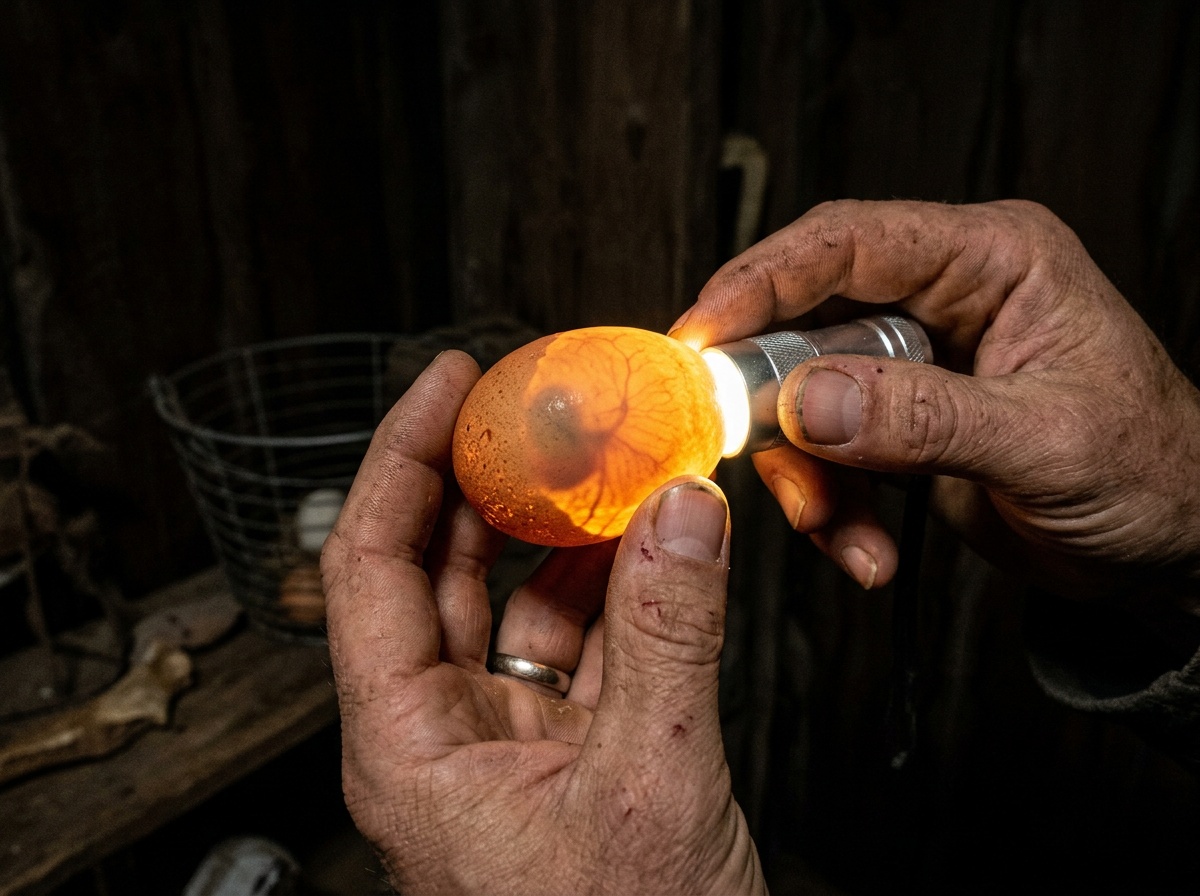
Tips that save batches:
- Dark shells are harder; move to a very dark room and use a focused LED.
- First quick look after three to seven days often shows a fine vascular web; compare with a clear infertile or stalled egg.
- A thin blood ring often means early death—remove that egg before it ruins the air quality.
- If unsure, mark questionable eggs and recheck around twelve to fourteen days; obvious duds get tossed.
Lockdown, pipping, and assisting (rarely)
From about day 18, stop turning. Chicks orient for hatch; extra jostling wastes energy.
You may see rocking first, then a pip—a small hole. Many chicks hatch eight to twelve hours after the first pip, though stragglers can take longer.
Assisted hatch is emergency-only. If you peel shell too early before blood vessels recede into the body, you can cause fatal bleeding. If a chick has pipped and made no progress for 24–36 hours and you are experienced, some keepers intervene with sterile technique and constant moisture—but beginners usually improve outcomes by waiting.
After hatch
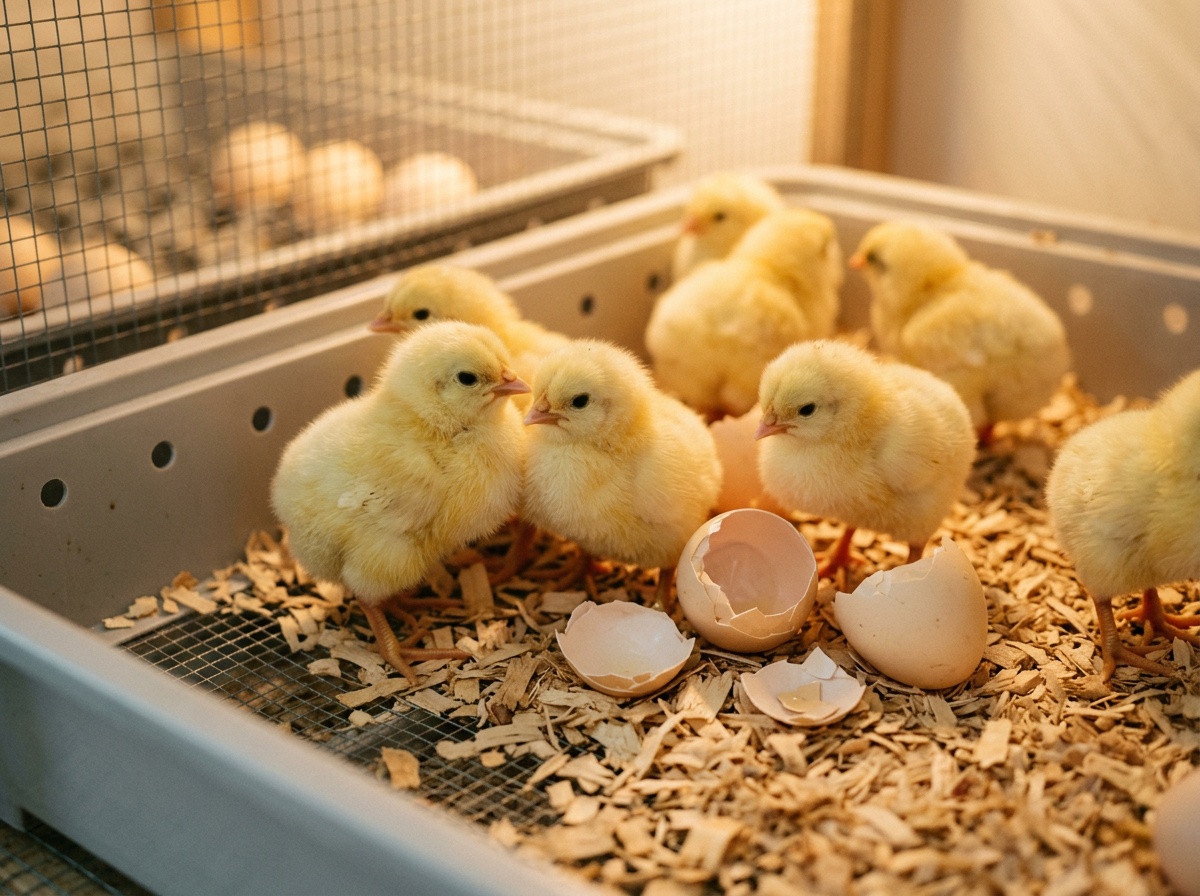
Remove shell debris to cut down bacteria, but leave chicks until dry and fluffy. Then move them to a draft-free brooder with reliable heat (many use a lamp or plate), fresh water with marbles or a shallow dish, and easy crumble feed.
Egg brooding vs mechanical incubation
Egg brooding under a hen gives tuned microclimate tweaks you will never perfectly copy—plus a teacher for peachicks learning to forage. Mechanical incubation wins on scale, scheduling, and predictability. Many serious homesteaders run both: incubator for volume, broody for hard-to-hatch breeds or overflow.
Troubleshooting fast hits
- Sticky, gluey chicks: often humidity imbalance late—review lockdown RH and ventilation plugs.
- Early pips, late zips: temperature shifts or poor calibration—re-seat probes, avoid drafts on the sensor.
- Exploding or foul eggs: hygiene issue or hidden crack—pull stinkers immediately, consider moving survivors to a clean spare incubator if available.
Incubation of hen eggs: ducks and geese (orientation only)
The article above targets chicken / hen egg incubation. Waterfowl frequently need longer sets, different humidity habits, and sometimes brief cooling periods per breeder protocols. If you also raise waterfowl, follow a species-specific chart: ducks and geese need different set lengths and humidity habits than chickens, and mixing species in one table is easy to misread.
FAQ
How do you incubate chicken eggs?
Warm a clean incubator to a stable target, set fertile eggs with automatic or manual turning until lockdown, candle to remove dead germs, raise humidity for hatch, then move dried chicks to a brooder.
How incubate eggs (manual turning version)?
Roll each egg three to four times daily, alternating direction, keeping the lid closed except during turns—same thermals as an automatic rack, more discipline.
How to hatch eggs in an incubator without ruining humidity?
Add humidity slowly with pre-warmed water, keep vents per manual guidance, and open the lid only briefly during lockdown if at all.
How do you hatch an egg that stops developing?
You cannot force development. Candle, identify quitters (clear eggs, stalled growth, blood ring), and discard early so the rest of the batch stays clean.
What is the difference between egg brooding and incubation?
Brooding is a hen sitting the clutch; incubation in a machine copies her heat, humidity, and turning on your schedule.
What does the egg incubation process cost in attention?
Plan twice-daily checks (more during hatch), spare parts for the turner, and backup power plans if outages are common where you live.
Legal and animal-welfare note
Laws on poultry sales, imports, and backyard flocks vary by state and municipality. Pair this how-to with local rules and a vet or extension office when disease pressure is high. This article is practical education, not veterinary advice.