A Safer Way to Learn Which North American Flowers Belong on the Plate
Learn a practical, safety-first method for recognizing edible flowers in North America, avoiding toxic ornamentals, sourcing clean blooms, and using them carefully at home.

Edible flowers can add color, mild flavor, and seasonal variety to home cooking, but they are not a casual forage. Many flowers in North America are safe only when correctly identified, grown without unsafe chemicals, and prepared with care. Others are poisonous enough to cause serious illness from a small amount. This guide focuses on identification basics, source safety, and practical home use so beginners can make better decisions and avoid common mistakes.
Important safety note: This article is general information only. It is not a substitute for in-person plant training, local expert confirmation, or medical advice. Never eat a flower unless you can confirm its scientific name and verify that species as edible from a reliable source. If you are pregnant, breastfeeding, managing chronic illness, or taking medications, ask a qualified healthcare professional before adding new floral or herbal foods.
What counts as an edible flower in North America?
An edible flower is a bloom from a plant with a documented history of safe culinary use. That does not mean every flower in a yard, bouquet, or wild patch is safe. It also does not mean every part of the plant is edible. In many cases, only the petals are commonly used, while the stamens, pistils, or green base of the flower are removed because they are bitter or more likely to irritate the mouth or stomach.
Well-known beginner examples include nasturtiums, pansies and violas, calendula, chive blossoms, and flowers from familiar culinary herbs such as basil, thyme, rosemary, and sage. These are generally easier to verify than random ornamental blooms. The realistic value of edible flowers is culinary, not medicinal. They can contribute flavor, appearance, and a small amount of nutrients, but they should not be treated as a cure or detox food.
Before you taste, the golden rules of flower safety
The first rule is simple. If you cannot positively identify the flower to species, do not eat it. Common names are not enough because one name may refer to several different plants in different regions. Scientific names matter because they narrow the plant down to a specific species with known traits and safety information.
The second rule is source control. A flower can be edible in theory and still unsafe in practice if it came from a florist, nursery ornamental bench, roadside, parking lot edge, or public landscape bed with unknown spray history. Many ornamental flowers are treated with pesticides or grown in contaminated soil. A safe edible flower should come from a food-grade source, a trusted grower, or your own garden where you know exactly what was applied.
The third rule is to start small. Even well-documented edible flowers can trigger oral irritation, pollen reactions, or digestive upset in sensitive people. Try a tiny amount first and wait before eating more.
How to identify an edible flower safely
Beginners often focus on bloom color first, but color is one of the least reliable features. Many unrelated plants produce similar colors. Safer identification comes from looking at the whole plant, not just the flower head.
Leaf, stem, and growth habit clues
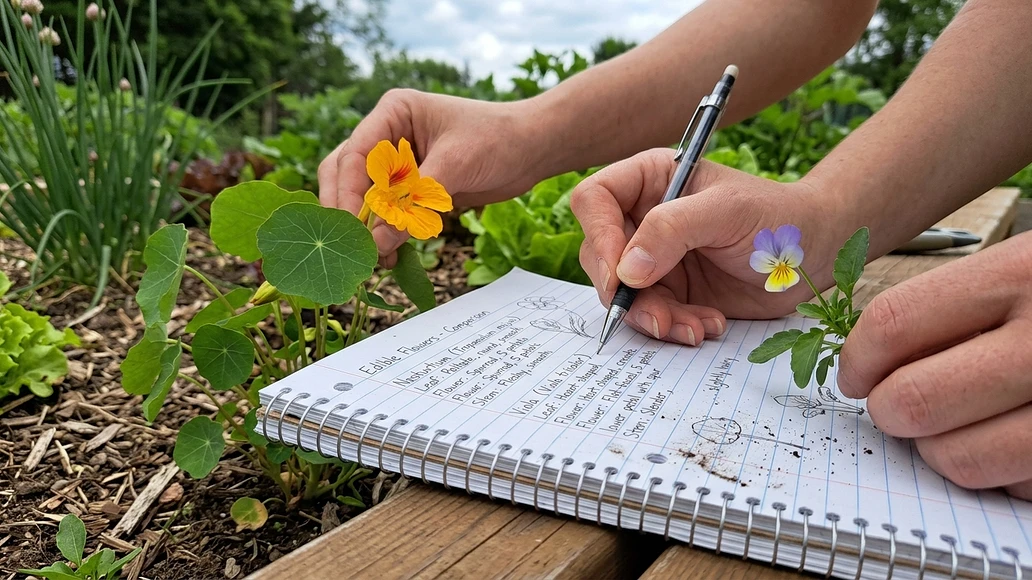
Leaves often tell you more than petals do. Look at whether leaves are opposite or alternate on the stem, whether edges are smooth or toothed, whether the surface is hairy or waxy, and whether the plant forms a low mound, upright spike, vine, or clump. Stem texture also matters. Some toxic plants have milky sap or thick, unusual stems that should raise caution. Growth habit can help separate a culinary herb flower from a dangerous ornamental.
For example, chive blossoms grow on hollow, onion-scented stems from a clumping allium. Nasturtiums usually have rounded shield-like leaves and a sprawling habit. Herb flowers tend to appear on plants whose leaves already have a familiar culinary scent. If the leaves and stems do not match the plant you think you found, stop there.
Flower structure and symmetry
Flower shape is more useful than color. Ask whether the bloom is radial, with petals arranged evenly around a center, or bilateral, with a clear top and bottom. Notice whether flowers appear singly, in spikes, in daisy-like heads, or in umbrella-shaped clusters called umbels. Umbels deserve special caution because edible carrot relatives can be confused with highly poisonous plants such as poison hemlock.
Also inspect how many petals are present, whether petals are fused into a tube, and whether the flower hangs downward or stands upright. Foxglove, for instance, produces tubular flowers on tall spikes, a pattern that should immediately trigger caution rather than curiosity.
Habitat, season, and plant context
Where a plant is growing is part of identification. A flower in a vegetable bed or herb border is easier to verify than one growing on a roadside shoulder, drainage ditch, abandoned lot, or mixed ornamental planting. Season matters too. If a plant is blooming far outside its normal window for your region, double-check the identification. Regional variation, invasive species, and local cultivars can all complicate assumptions.
Use context as supporting evidence, not proof. A flower growing in your yard is not automatically safe, and a flower growing wild is not automatically natural or edible.
Toxic garden flowers that beginners should avoid entirely
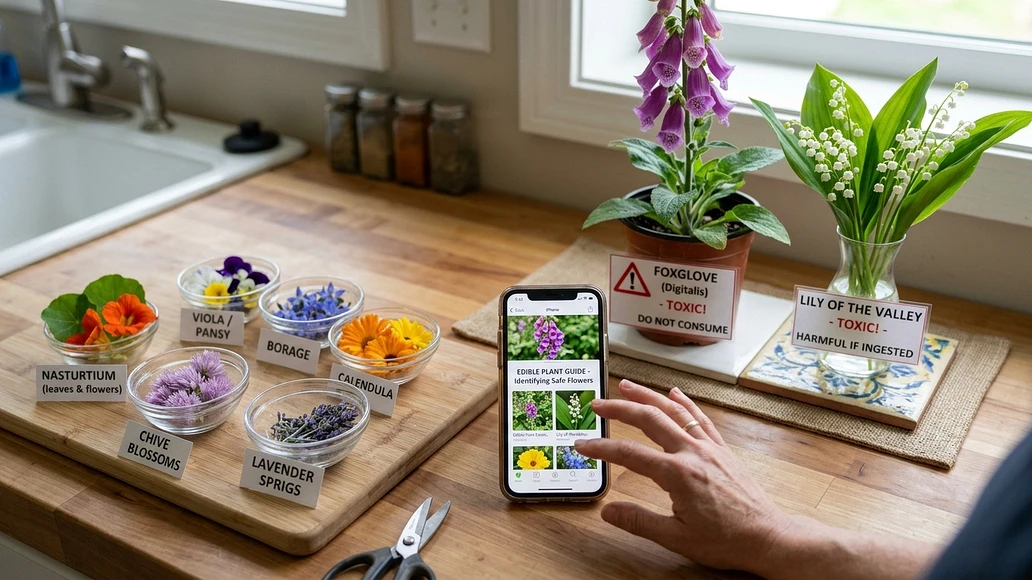
North American gardens contain many beautiful flowers that should never be eaten. High-risk examples include oleander, foxglove, lily of the valley, monkshood, azalea, rhododendron, hydrangea, buttercups, and many Euphorbia species. Some affect the heart, some irritate the mouth and digestive tract, and some can cause severe poisoning.
A good beginner rule is this. If a flower is mainly known as an ornamental and you have not seen it repeatedly documented as a culinary flower, treat it as inedible until proven otherwise. The table below highlights common confusion points.
| Common edible flower | Common toxic look-alike or confusion risk | Key differences to check | Risk notes |
|---|---|---|---|
| Nasturtium | Buttercup or unrelated bright yellow ornamentals | Nasturtium has round shield-like leaves and a peppery scent. Buttercups usually have glossy yellow flowers and very different divided leaves. | Do not rely on yellow or orange color alone. |
| Chive blossom | Non-edible ornamental alliums or random purple pom-pom flowers | True chives have hollow leaves and a clear onion aroma. If there is no onion scent, do not assume it is edible. | Allium scent is a major clue, but still verify species. |
| Viola or pansy | Decorative bedding flowers with similar face-like blooms but unknown treatment history | Use only plants sold or grown for culinary use. Bedding plants may be heavily treated. | Source safety is often the bigger issue than look-alike risk. |
| Calendula | Ornamental daisy-family flowers | Calendula has resinous, slightly sticky stems and classic marigold-like blooms, but many daisy-family flowers are not interchangeable. | Do not assume all marigold-type flowers are edible. |
| Queen Anne's lace, advanced foragers only | Poison hemlock | Hemlock has dangerous toxicity, often smooth stems with purple blotches, and should never be sampled. Umbel plants are not beginner material. | Avoid wild umbel flowers unless trained by an expert. |
| Herb flowers such as basil or thyme | Unfamiliar ornamentals in mixed beds | Confirm the leaves first. Culinary herb flowers should grow on the same plant as the recognizable edible herb. | If the leaf does not match the herb, do not eat the flower. |
Use regional tools, not guesswork
North America is large, and plant distribution matters. A species common in one state may be absent in another, and some plants have regional relatives that complicate identification. The USDA PLANTS Database is useful for checking scientific names, range, and baseline plant information. State cooperative extension services are even better for local growing conditions, toxic plant alerts, and region-specific guidance.
A practical workflow looks like this. First, identify the plant candidate using multiple visible traits. Second, confirm the scientific name. Third, check whether that species is documented as edible by a reliable source. Fourth, compare it against poison plant resources and local extension materials. Fifth, verify that the source was grown for food and not treated as an ornamental.
Plant ID apps can help narrow possibilities, but they are not enough by themselves for something you plan to eat. Use them as a starting point, then confirm with field guides, extension resources, or an experienced local grower.
Where safe edible flowers actually come from
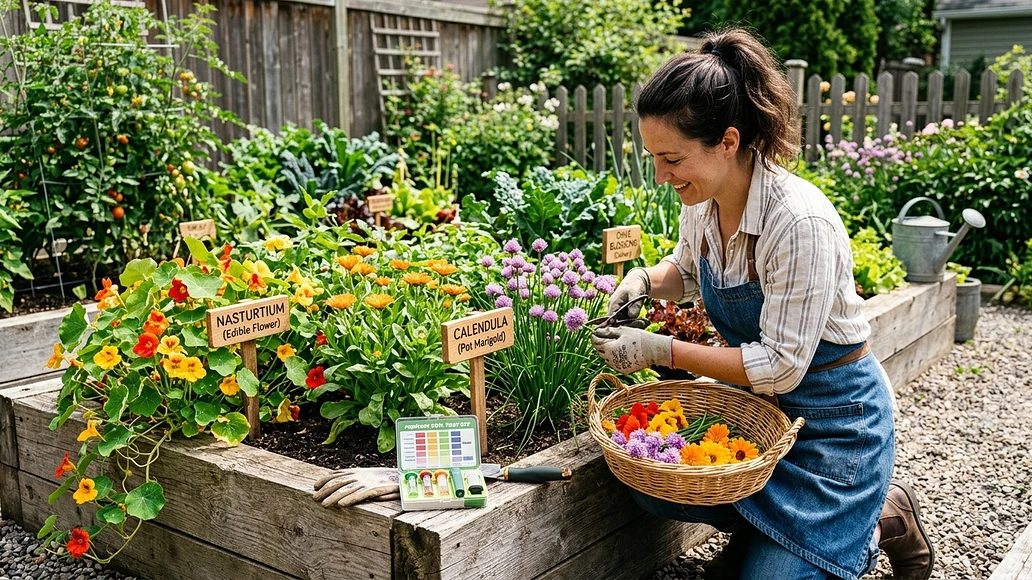
The safest flowers are the ones you grow yourself from culinary-grade seed or starts, using food-safe gardening practices. The next best option is a trusted local grower who can tell you exactly what was sprayed, when it was sprayed, and whether the flowers were produced for food use. Florist bouquets and nursery ornamentals should be treated as off-limits.
| Source type | Safety status | Main concern | Safer alternative |
|---|---|---|---|
| Home garden, no synthetic pesticides used on blooms | Best option | Need accurate species confirmation and clean soil | Grow from culinary-grade seed and keep records |
| Local farmer selling culinary-grade flowers | Usually good | Need to ask about sprays and post-harvest handling | Buy from growers who market flowers specifically for food |
| Certified organic edible flower producer | Strong option | Still wash and inspect before use | Choose labeled food-grade blooms |
| Florist bouquet | Unsafe | Not grown for food, possible preservatives and pesticide residues | Buy culinary flowers instead |
| Nursery bedding plants or ornamentals | Usually unsafe for eating | Unknown systemic pesticide use | Use untreated starts intended for edible production |
| Roadside or parking-lot flowers | Unsafe | Exhaust, dust, herbicides, heavy metals, pet waste | Harvest only from clean private land with permission |
| Public park or landscape bed | Unsafe unless management is known | Unknown spray history and contamination | Ask land managers, otherwise avoid |
Pesticides, pollution, and soil contamination
Recent concern around pesticide residues on ornamental flowers is one of the biggest reasons to avoid non-food blooms. Flowers grown for appearance may be treated with products that are not intended for edible use. Some pesticides are systemic, which means washing does not necessarily remove what the plant absorbed internally.
Urban soil is another hidden issue. Soil near older homes, busy roads, and industrial areas may contain lead or other contaminants. If you want to grow edible flowers in a city or older neighborhood, consider a soil test and use raised beds with clean soil if needed. Also avoid harvesting from places exposed to traffic spray, drifting herbicides, or runoff.
Clean petals start with clean growing conditions. Washing helps remove dust and small insects, but it cannot fix a contaminated source.
A practical edible flower safety checklist
Use this sequence every time, especially when you are new.
- Confirm the plant to species, not just by common name.
- Verify that the species is documented as edible from a reliable source.
- Make sure the flowers came from a food-safe source with known spray history.
- Check whether only certain parts are eaten, often petals only.
- Remove damaged petals, insects, stamens, pistils, and bitter green bases when appropriate.
- Rinse gently and dry carefully.
- Try a very small amount first.
- Stop immediately if there is oral burning, rash, stomach upset, wheezing, or other symptoms.
| Flower species | Common edible part | Parts often removed | Preparation note |
|---|---|---|---|
| Nasturtium | Petals and sometimes whole flower | Tough stem end if present | Peppery flavor, use fresh in salads |
| Pansy or viola | Petals or whole bloom | Stem base if tough | Best for garnish, desserts, and salads |
| Calendula | Petals | Center and green base | Petals can be scattered into rice, butter, or baked goods |
| Chive blossom | Individual florets | Tough stem and any dry parts | Mild onion flavor, good in savory dishes |
| Basil flower | Flower spikes in small amounts | Tough stem sections | Use where basil flavor fits naturally |
| Rose, culinary unsprayed only | Petals | White petal base if bitter | Fragrant varieties work best for syrups and desserts |
Harvesting and storing flowers at home
Harvest in the cool part of the morning after dew has dried but before midday heat wilts the blooms. Choose freshly opened flowers without browning edges. Use clean scissors or snips and place blooms gently into a shallow container so they do not crush each other.
Once indoors, inspect for insects, rinse lightly if needed, and dry on towels or in a salad spinner on a gentle setting. Store them refrigerated in a breathable container lined with paper towel. Most flowers are best used the same day or within a day or two. Their quality drops quickly, and bruised petals spoil faster than leafy herbs.
How much is safe to eat, and who should be more cautious?
There is no universal daily serving standard for edible flowers. For most people, they should remain a garnish or small ingredient, not a bulk food. Start with a tiny amount of one species at a time. This makes it easier to notice reactions and identify the cause.
People with pollen allergies, hay fever, asthma, or a history of food sensitivities should be especially careful. Children should only be offered flowers that are very well documented and from safe sources, and only in small amounts. Pregnant or breastfeeding people, and anyone with heart, kidney, or liver disease or who takes cardiac or anticoagulant medications, should keep to a short list of well-known culinary flowers and ask a clinician before experimenting.
Foraging wild flowers, laws, ethics, and sustainability
Wild foraging adds another layer of risk because you must identify the plant and evaluate the site. You also need permission. Many parks, preserves, and public lands restrict or prohibit collecting plants. Private land requires owner permission. Some native species are protected, and harvesting them may be illegal or ecologically harmful.
If you do forage, avoid rare species, avoid taking entire patches, and never strip an area bare. Invasive edible plants may sometimes be legal and useful to remove, but only if you are certain of the identification and local rules. For beginners, garden-grown flowers are far safer than wild ones.
Beginner-friendly flowers to learn first
The easiest starting point is a short list of flowers with strong culinary documentation and low confusion risk when grown at home. Pansies and violas are simple to recognize in your own containers. Nasturtiums are distinctive and easy to grow from seed. Calendula is widely used for petals. Chive blossoms are straightforward if the onion scent is obvious. Herb flowers from basil, thyme, rosemary, and sage are also approachable because the leaves help confirm the plant.
Learning a few reliable species well is better than collecting a long list of uncertain ones.
Common mistakes people make with edible flowers
The most common mistake is trusting color or beauty instead of full identification. The second is eating flowers from bouquets, garden centers, or landscaping beds. The third is assuming that if the leaves or roots of a plant are edible, the flowers must be edible too. Plant parts can differ in safety. Another mistake is trying too many new flowers at once, which makes reactions harder to track. Finally, many people overlook site contamination and harvest from roadsides or urban lots that look wild but are not clean.
If you suspect plant poisoning
Possible symptoms include mouth burning, drooling, vomiting, severe stomach pain, diarrhea, dizziness, confusion, trouble breathing, or an irregular heartbeat. Severity depends on the plant, the amount eaten, and the person affected.
| Situation or symptom | Immediate home step | When to call poison control | When to seek emergency care |
|---|---|---|---|
| Unknown flower was eaten, no symptoms yet | Remove plant material from mouth and rinse with water | Call right away for guidance | Go now if a child, pet, or high-risk adult is involved and the plant may be toxic |
| Mild mouth irritation or mild nausea | Stop eating, rinse mouth, keep sample or photo | Call for advice the same day | Go if symptoms worsen or the plant is known to be poisonous |
| Vomiting, severe abdominal pain, repeated diarrhea | Do not keep eating or drinking unusual remedies | Call immediately | Seek urgent care or ER evaluation |
| Trouble breathing, confusion, fainting, seizure, irregular heartbeat | Call emergency services immediately | Yes, if possible while help is on the way | Emergency care is needed now |
Bring a photo or sample of the plant if it can be done safely. Do not induce vomiting unless a medical professional tells you to do so.
FAQ
Can you eat flowers from a regular florist bouquet?
No. Florist flowers are generally not grown as food and may carry pesticide residues, preservatives, or dyes. Treat bouquet flowers as decorative, not edible.
Are wild roadside flowers safe to forage and eat?
Usually not. Even if the species is edible, the location may expose it to exhaust, herbicides, heavy metals, runoff, and other contamination. Roadside flowers are a poor choice for food.
How can I tell if a flower in my yard is poisonous?
You cannot tell by appearance alone unless you already know the species well. Confirm the scientific name, compare the whole plant, and check reliable edible and poisonous plant references. If there is any doubt, do not eat it.
Is it safe for children or pregnant people to eat edible flowers?
Extra caution is wise. Stick to a very short list of well-documented culinary flowers from safe sources, serve only small amounts, and ask a healthcare professional if there are any medical concerns.
Do plant ID apps make it safe to eat a flower I find?
No. Apps are useful for narrowing options, but they can misidentify plants. Use them as one tool, then confirm with trusted references or local experts before considering any plant edible.
What the evidence supports, and what it does not
| Topic or claim | Evidence strength | Practical takeaway |
|---|---|---|
| Only eat flowers you can positively identify to species | Well supported | This is the core safety rule |
| Avoid florist, roadside, and unknown-spray flowers | Well supported | Source safety matters as much as species |
| Petals only are often the safest edible portion | Well supported | Remove bitter or irritating parts when recommended |
| Use extension resources, field guides, and USDA tools for ID | Well supported | Do not rely on memory or apps alone |
| Start with tiny amounts and increase slowly | Well supported | Helps reduce reaction risk and makes symptoms easier to track |
| Edible flowers provide major health benefits | Mixed to weak | Think flavor and garnish first, not medicine |
| Field taste tests can prove a flower is safe | Mixed and risky | Not a substitute for identification, beginners should avoid this approach |
| Urban soil testing before growing edible flowers | Well supported | Especially important in older city lots |
| Edible flowers detox the body or treat disease | Weak or unsupported | Avoid these claims |